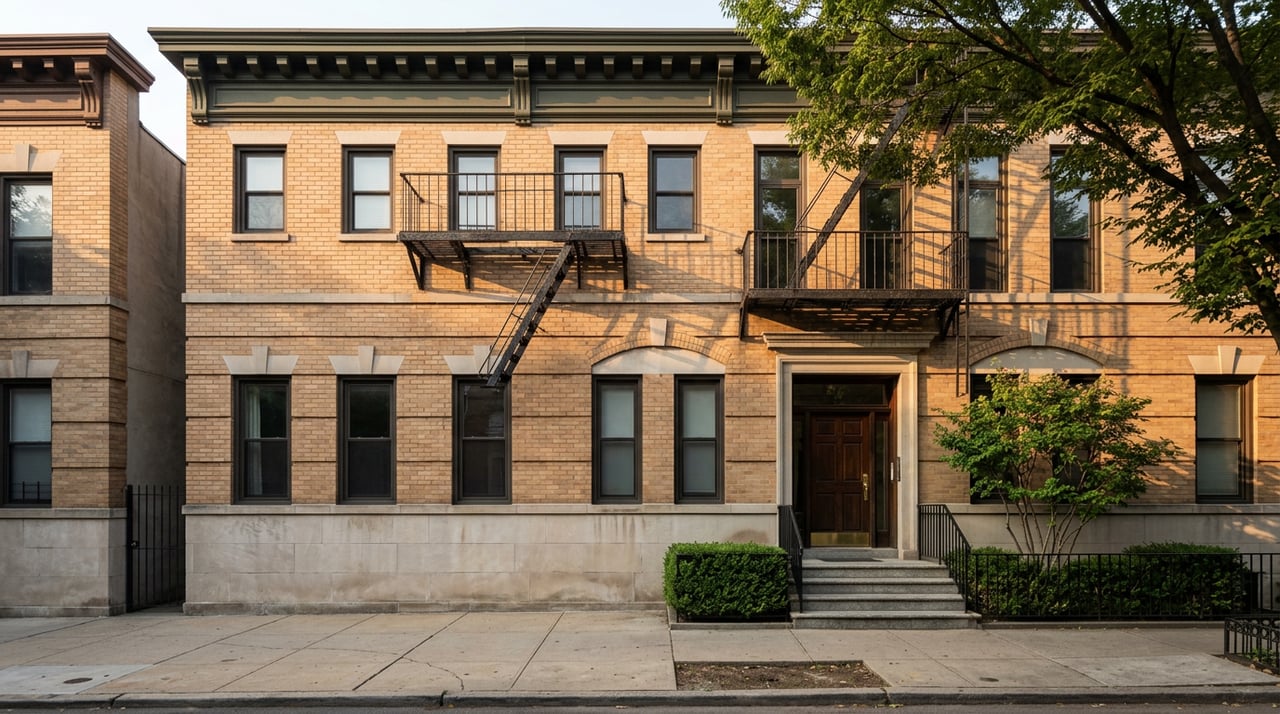
The headline number every move-up buyer sees first is the spread between the Upper West Side condo median and the co-op median. In April 2026, PropertyShark put condos at $2.4M and co-ops at $1.4M. A million dollars is a lot of daylight, and it frames the decision as a straightforward budget question. It is not.
The gap you can see on a listing page is a poor proxy for the gap you will actually feel on a monthly basis, at closing, and again when you sell. On the Upper West Side specifically, the mechanics of prewar co-op ownership hide costs a condo makes explicit, and the mechanics of a newer condo hide costs a prewar co-op makes explicit. Same price, different bill.
The number that sets up the wrong question
Neighborhood medians are useful for orientation and almost nothing else. Redfin recorded a median UWS sale price of $1.6M for the three months ending April 2026, up 12.0% year over year, with homes sitting 84 days on market. PropertyShark's April 2026 pull showed a neighborhood median of $1.85M and a median price per square foot of $1,677. Live UrbanDigs data for the week of May 25, 2026 had UWS condo price per square foot up 11.2% year over year and days on market compressed to 65.
Those numbers all measure something real. None of them tells you what a specific apartment will cost you to own.
The list price is where the conversation starts. The maintenance charge, the tax bill, and the building's balance sheet are where the conversation ends.
What the maintenance line actually contains
The most consequential difference between a prewar UWS co-op and a newer UWS condo is not architectural. It is fiscal. A 1925 prewar co-op selling for $2M today typically carries an effective annual property tax bill of $8,000 to $15,000, because Class 2 residential in New York City taxes a fraction of market value and prewar assessments have historically lagged. A newly built $2M condo across the street, assessed closer to market, can run $20,000 to $35,000 in annual property tax, and the number climbs further once any 421-a abatement phases out. That is a $1,000 to $2,000 monthly difference in property tax alone, before either building sends its first maintenance or common-charge invoice.
The prewar co-op appears cheaper on paper because its property tax is not itemized in the listing. It sits inside the maintenance figure, along with the building's share of an underlying mortgage that most co-ops carry and most condos do not.
| Line item | $2M UWS prewar co-op | $2M UWS newer condo |
|---|---|---|
| Property tax (annual) | $8,000–$15,000, bundled into maintenance | $20,000–$35,000, billed separately |
| Underlying building mortgage | Building carries it; your share sits in maintenance | Generally none |
| Reserve funding | Partly funded by flip tax at each resale | Funded through common charges and assessments |
| Down payment floor | Typically 20% minimum, often higher by board rule | Typically 10% minimum |
| Closing timeline | 3 to 4 months after contract, per Corcoran | 1 to 3 months after contract, per Corcoran |
Read that table twice. The co-op looks cheaper because two large expenses are folded into one number. The condo looks expensive because everything is unbundled. The buyer who compares maintenance to common charges without adjusting for tax is comparing the wrong quantities.
The flip tax lands on the sell side, not the buy side
Roughly 90% of Manhattan co-ops charge a flip tax, and the most common structure is 2% of the sale price. On Central Park West and other landmark prewar buildings, the rate can reach 3.5%. The fee is set by building bylaws and cannot be negotiated on its face. Who writes the check, buyer or seller, sometimes is negotiable and sometimes is not.
For a mid-funnel reader, the flip tax matters most as a resale drag. A $2M UWS co-op with a 3% flip tax generates a $60,000 fee at closing, paid into the building's reserve fund rather than to a government body. Add the New York City and State transfer taxes, capital gains, and broker fees, and the seller's net on a co-op can trail the seller's net on a same-price condo by a full percentage point of sale price or more. Buyers who plan to hold ten years or longer absorb this cost quietly. Buyers with any chance of moving inside five years should model it explicitly.
Where the negotiation asymmetry lives
The other under-discussed piece of the UWS decision is how much room each product actually gives you at the offer stage. Corcoran's March 2026 Manhattan condo and co-op report showed signed contracts averaging 2.8% below the last asking price. Broken out, condos closed 3.7% below ask and co-ops closed 1.2% below ask.
That gap is not a fluke. Co-op sellers are more constrained on price because boards have grown stricter about post-tax income, debt-service ratios, and reserve requirements through the 2024 to 2026 cycle. Boards have rejected price-cut deals where the reduced number made the buyer's financials look thin against building standards. In practical terms, a co-op seller cannot always take a lower offer even if they want to, which supports the ask and limits the discount available to buyers. Condo sellers face no such constraint, which is one reason the 3.7% average discount is more than triple the co-op figure.
If you are a financed buyer targeting the $2M to $4M range on the UWS, that spread is where real dollars live.
The three documents that decide the deal
Before you sign a contract on a UWS co-op, ask your attorney for these three items and read them yourself:
- The reserve fund balance and the capital assessment history for the last five years. A thin reserve on a prewar building is a special assessment waiting to happen.
- The underlying building mortgage. Co-op buildings can and do carry debt. The size of it, the rate, and the maturity date all feed directly into your monthly maintenance now and after the next refinance.
- The last 24 months of board meeting minutes. Look for pending facade work, elevator replacement, plumbing riser projects, or Local Law 11 obligations. On a 100-year-old CPW or Riverside Drive building, these are not hypothetical.
For condos, the equivalent read is the offering plan, the last two years of common charge history, and any resolutions authorizing capital projects. The New York State Attorney General's office specifically flags facade, roof, elevator, plumbing, heating, and electrical items as places where large expenses show up on older buildings, and reminds buyers that for new development, the offering plan controls what the sponsor must deliver, not the sales brochure.
Why UWS supply makes this a today problem, not a someday problem
The reason this trade-off is sharper on the UWS than in most other Manhattan submarkets is supply. Bloomberg reported a projection of roughly 51 new UWS condo units expected through 2028, a steep drop from the 2016 to 2019 development wave. StreetEasy's current UWS inventory sits around 959 active listings, split roughly evenly between 498 condos and 415 co-ops.
Translation: the newer condo product that a move-up buyer might prefer is not being replenished. Existing condos are being bid up while co-op inventory rebuilds. Median condo price per square foot rose 11.2% year over year in the week of May 25, 2026, per UrbanDigs. Larger prewar co-ops, particularly along Central Park West, West End Avenue, and Riverside Drive, are increasingly the only path to family-size square footage on the UWS without stretching to $3M-plus condo pricing.
A buyer who dismisses co-ops on process grounds is, in this market, dismissing most of the neighborhood's large-format inventory.
FAQ
Does the maintenance always include property tax on a UWS co-op? Yes. Co-op maintenance is a per-share monthly charge that funds building operations, the underlying mortgage, and the building's real estate tax bill. Condo owners receive a separate quarterly property tax bill from the city.
Can a co-op board actually reject an accepted offer over price? Yes. Boards review buyer financials against building standards, and a lower sale price can push a buyer's post-close liquidity or debt-to-income ratios below building minimums. This has become more common through the 2024 to 2026 cycle.
Is the flip tax deductible or offset against capital gains? Treat it as a transaction cost that reduces your net proceeds. This post is market commentary, not tax advice; the specific treatment on your return is a conversation for your accountant.
If you are weighing a specific UWS building against a specific condo alternative, the answer is rarely visible from the listing sheet. It sits in the maintenance breakout, the reserve fund, and the flip tax schedule. Ann Ferguson LLC has spent decades reading those documents on the Upper West Side. Schedule a Complimentary Market Evaluation to see what your budget actually buys once the numbers are on the same footing.